My most anticipated books of 2026 (so far)

It’s a treat to run into a dear friend in an unusual context. One recent Tuesday, my evening was brightened by bumping into my neighbor Anna at Thank You Books. As we clutched our books (“44 Poems for Being with Each Other” for me, “The Correspondent” for her), she proclaimed that she wanted a notification every time I preorder a book. It should be automated and include a brief explanation of why I bought the book, along with a “buy now” link.

I don’t have the tech savvy to set up such a system, and frankly I’m not sure I could without relinquishing more privacy than I’m comfortable with. But! I do have a blog and I can craft a quick post to satisfy my friend’s craving.

So, for Anna: Here are the books I’ve preordered in 2026 (so far). For those of you who aren’t regulars at Thank You Books, I’ll include a Bookshop.org link, also. Note that I am a Bookshop.org affiliate and will receive a commission for any purchases made using the site’s links below.

Cover of 44 Poems on Being with Each Other by Padraig OTuama features a series of stylized stones on a neutral background

44 Poems for Being with Each Other
Pádraig Ó Tuama  
Pub date: Feb. 10 (paperback)
Publisher: W.W. Norton & Company
Genre: Poetry anthology
Bookshop.org link
One of the best gifts I’ve given myself was Ó Tuama’s “Poetry Unbound.” Last year I read one chapter a day until I’d completed the book, and it was a highlight of those 50 mornings. Ó Tuama, who is the host of the On Being podcast Poetry Unbound, introduces each poem with a short reflection and follows it with an essay. Some essays are about white space, or language or the poet’s word choice. But just as often, Ó Tuama weaves in his own experiences. The book felt like a collegiate introduction to poetry class, and I was hooked. “44 Poems on Being with Each Other” follows the same format but focuses on poems about human interaction. It’s out in paperback this month. Though I didn’t realize this when I ordered it, it was the perfect Valentine’s gift to myself.

The Optimists
Brian Platzer
Pub date: Feb. 24
Publisher: Little, Brown and Company
Genre: Literary fiction, humor
Bookshop.org link
A perk of book reviewing is the monthly assignment emails from my editors; these roundups of books they plan to assign give me a glimpse of what’s exciting in the year’s publishing calendar. I didn’t snag “The Optimists” for review because it was only available in digital forms, and I only read in print. But the description enticed me: a teacher’s reflection on his brightest student melded with the retelling of his own history and love of story? Yes, please.

A sky blue background with a bright red school chair with a broken leg. The cover of The Optimists by Brian Platzer

The Glorians
Terry Tempest Williams
Pub date: March 3
Publisher: Grove/Atlantic
Genre: Nature, memoir, spirituality
Bookshop.org link
I haven’t read everything Terry Tempest Williams has published, but I’ve just nearly bought all of her books. (Reading and purchasing are separate but related hobbies.) We’re on a standard preorder basis now. I’ll admit I had to pull up the book on TYB’s website to reacquaint myself with its synopsis. Glorians are ordinary beings that point attention toward our interconnectedness in the world. In “The Glorians,” Williams draws a line between these beings and the fragile world we call home. Her blend of science and spirituality always resonates with me and reminds me that there’s still hope to be had.

Nightfaring: In Search of the Disappearing Darkness
Megan Eaves-Egenes
Pub date: March 31
Publisher: Grand Central Publishing
Genre: Nature, science
Bookshop.org link
March will lean into nature and connection, and I couldn’t be more excited for Megan Eaves-Egenes to continue that theme. Eaves-Egenes is a travel writer and dark sky advocate, and she’s also an old friend. We bonded over a love of music in the early 2000s and have both gone on to write about a variety of topics. As soon as I learned her debut book was forthcoming, I preordered a copy. In “Nightfaring,” Eaves-Egenes writes about traveling the world and navigating her personal experiences to understand the human relationship with the dark.

Three women toast beers at a restaurant table. Two smile at the camera, and one takes a sip from a beer.

What the Mirror Said: The Necessity of Black Women in Poetry
Ashley M. Jones
Pub date: April 21
Publisher: University of Michigan Press
Genre: Literary criticism, essays
Bookshop.org link
This isn’t just a list of books by people I know, but I am fortunate to have known some amazing writers. Ashley M. Jones is high on that list. Jones was Alabama’s youngest and first Black poet laureate, and I’m currently working my way through her recent collection “Lullaby for the Grieving.” (Expect it to make a future appearance in The Grief Library.) Jones mentioned “What the Mirror Said” in a recent interview with The Birmingham Times, and her description quickly persuaded me: “It combines personal essay with close reading. There’s something for the academic types and something for the non-academic types. I explore nine Black women poets who’ve influenced my life in person or on page or both.”

The Radiant Dark
Alexandra Oliva
Pub date: April 28
Publisher: SJP Lit
Genre: Popular fiction, literary fiction
Bookshop.org link
Even with books sections on the decline and claims that people don’t read anymore proliferating, there are still plenty of places to find book recommendations. I have no idea where I stumbled across this one, but its synopsis enticed me: It’s a multigenerational saga about a family learning to live in light of news that the universe includes living beings who don’t live on Earth. There’s suggestion of greater spiritual meaning here, as well as the family dynamics that can hook me. I’m eager to dive in.

I Would Die If I Were You: Notes on Art and Truth-Telling
Emily Rapp Black
Pub date: May 19
Publisher: Counterpoint
Genre: Memoir, self help, politics
Bookshop.org link
If you know me at all, you know this description sold me fast: “Drawing upon her previous work and over two decades of teaching, New York Times bestselling memoirist Emily Rapp Black explores how art can move us through moments of grief and loss while celebrating the spirit-lifting potential of all creative acts.” This is a hybird memoir and craft book that reckons with grief. I’m in.

Whistler
Ann Patchett
Pub date: June 2
Publisher: Harper
Genre: Literary fiction
Bookshop.org link
Confession: I much prefer Ann Patchett’s essays to her fiction. I’ve read several of her novels, and I usually like them fine. Her essays knock me over. At least, this was my take until her most recent novel, “Tom Lake,” which I devoured in a day. It’s the strength of that reading experience that bumped “Whistler” to my preorder list. A woman bumps into her former stepfather at the Metropolitan Museum of Art; though he was only married to her mother for a short while, his effect on her life lingered.

The Come Apart
Susannah Felts
Pub date: June 15
Publisher: TriQuarterly
Genre: Literary fiction
Bookshop.org link
I met Susannah many years ago now, sometime after reviewing her debut novel “This Will Go Down on Your Permanent Record” for Birmingham magazine’s summer reading feature. Susannah lived and worked in Birmingham at the time, and we got to know each other a bit before her family relocated to her hometown, Nashville. Susannah is now an essential part of that city’s literary community, where she’s a cofounder of literary nonprofit The Porch. Her newsletter “Field Trip” is also a wealth of artistic reflections. This is all to say: I’m a Susannah Felts fan. When she revealed the cover of “The Come Apart,” I fell in love. And it’s a novel about a touring band and art as a motivating life force. What’s not to love?

Country People
Daniel Mason
Pub date: July 7
Publisher: Random House
Genre: Literary fiction
Bookshop.org link
My book club rule is that spoilers are always allowed. If you didn’t finish the book before our meeting, that’s your problem. (I set this rule, and I’m the most frequent culprit of not doing the reading.) Even so, my friends kindly left key moments of “North Woods” for me to discover when I did finish reading that book. It’s a gorgeous novel about land, history, the environment and family, among other things. Please read it. My love of “North Woods” compelled me to preorder “Country People” (which also sounds great! Let’s spend a year with a family in Vermont!).

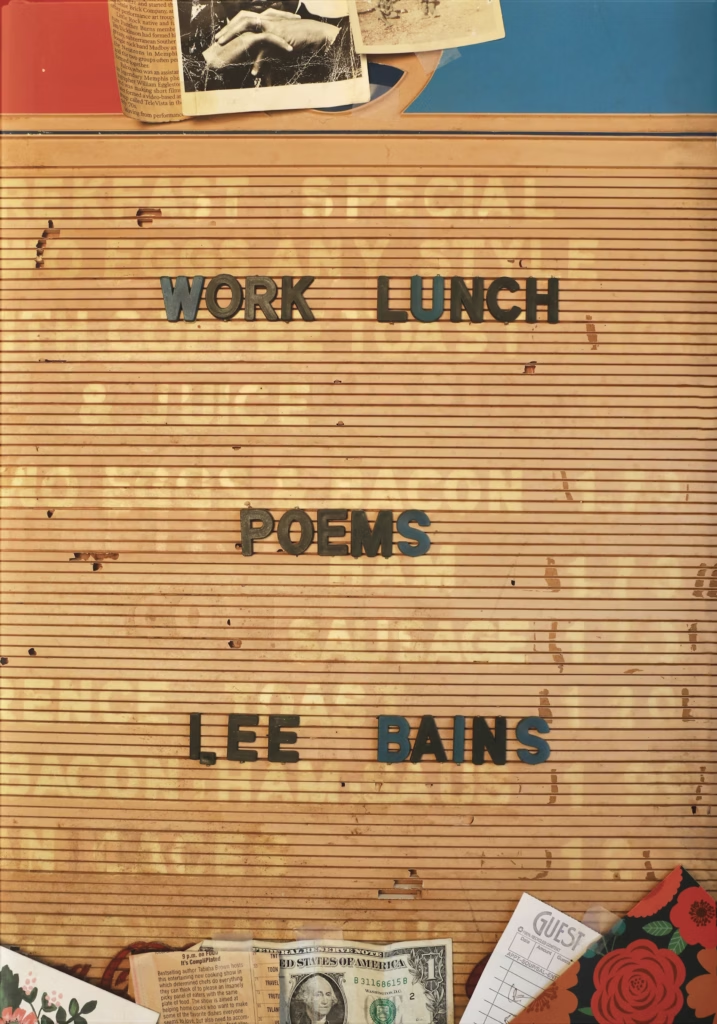
Work Lunch
Lee Bains
Pub date: Oct. 13
Publisher: Hub City Press
Genre: Poetry
Bookshop.org link
Lee Bains III and the Glory Fires is one of my favorite local-ish bands. While listening to a review copy of “Dereconstructed,” I shot Lee a quick email to request the lyrics to “Company Man.” I had the song on repeat and I needed to digest it. Well, Lee’s first poetry collection debuts this fall, and I hope it’s as satisfying as his music. (I still think that album should’ve hit it big.)

Partita (cover to come)
Barbara Kingsolver
Pub date: Oct. 6
Publisher: Harper
Genre: Literary fiction
Bookshop.org link
My book club has already declared this our October pick, though they’ve also issued a rule: Only members who have also read “Demon Copperhead” can participate. They’ve been on me to read that book as long as we’ve had the club–and I’m going to read it soon, I promise. Kingsolver often writes of life in rural communities, and “Paritita” will continue in that vein, this time exploring the story of a woman who dreamed of life as a pianist but is walking another path.

Vigil
George Saunders
Pub date: Jan. 27
Publisher: Random House
Genre: Literary fiction
Bookshop.org link
My first Saunders! Listen, the man is one of the world’s most renowned short story writers, but I’m generally not a fan of short stories. But after reading the synopsis of his new novel (a ghostly angel figure visits a horrible, dying man to bring him comfort, ethical conundrums ensue), after listening to one of my book club members rave about Saunders, after reading this great New York Times interview with him, I said fine. It’s time to try Saunders. And I enjoyed it! Enough that I’ve since purchased one of his short story collections, “Tenth of December.” I’ll note: “Vigil” is best read in one or two sittings. I read it over the course of a week, and that affected my enjoyment. But it’s definitely a reread for me, especially after listening to Book Riot: The Podcast’s lively discussion of the novel.

Note that I am a Bookshop.org affiliate and will receive a commission for any purchases made using the site’s links in this post.

Collective or individual, grief changes us

This is a story about 9/11.

You could argue that Bobby McIlvaine shouldn’t have been in the World Trade Center on Sept. 11, 2001. His Merrill Lynch office was a five-minute walk away. But that Tuesday, he helped a colleague set up for a conference at Windows on the World. Bobby was in the wrong place at the wrong time, and the people who loved him will spend the rest of their days missing him.

Early on, a therapist told the family that their experience was like being stranded on a mountain, each family member unable to help the others because of their own injuries. “You each have to find your own way down,” she said. But a psychology professor author Jennifer Senior interviewed saw a problem: “That suggests everyone will make it down … Some people never get down the mountain at all.”

Senior writes: “A lot of the theories you read about grief are great, beautiful even, but they have a way of erasing individual experiences. Every mourner has a very different story to tell.”

This is a story about the McIlvaine family and their specific loss. And, more broadly, this is also a story about all grief.

On Grief: Love, Loss, Memory
Jennifer Senior
Published: April 4, 2023 as this slim book; September 2021 in The Atlantic
74 pages
Genre: Nonfiction, reported essay
Type of grief: Death, sudden, trauma, child, sibling, romantic, communal

If you were alive on Sept. 11, 2001, it affected you in some way. Heck, there are ways it has affected you even if you were born later. Lower Manhattan will never appear the same. We’ve got the Department of Homeland Security. Airport security has changed radically. Many other flight changes have been economic rather than security-oriented, but in my subconscious they’re one and the same. My last flight in the “before” was to Denver and included a meal I recall as delicious. (I was 20. This may not have been true! But Delta still does a pretty good job when you catch a flight with meal service.) And I’m sure I checked my oversized suitcase for free.

9/11 also taught me about terrorism. I’m not sure I’d ever heard the term until I called my mom as I left class and walked to my car on that blue-sky day. Communications classes at Florida State, where I was a senior, were canceled before the rest of the university that day. As I headed off campus, I sought my mother’s explanation for what was happening. I probably consumed as much television news that day as I have combined in the years since.

For The Atlantic staff writer Jennifer Senior, 9/11 was a prominent lesson on grief, both communal and specific. Bobby was her brother’s roommate, had been for the eight years since they were randomly paired together in their freshman dorm. Senior loved Bobby and his family. And for the 20th anniversary of his death, she reported on how the people who loved him mourned and reeled from his death.

On Sept. 11, 2001, the McIlvaines slept together in their den as they awaited news about Bobby. They had learned that work took him to the Twin Towers that day, and even with phone lines down, it was unusual that he hadn’t found a way to communicate. I relate to the togetherness impulse. My parents and I stayed on the phone together the night we waited for the coroner’s call to confirm my sister’s death.

And in the aftermath of any tragedy, everyone is left with their individual grief. There are shared elements, of course there are. But we each bring our own perspectives and experiences to loss. Who we are afterward can be shaped by a collective grief, but we are our own creatures.

Bob Sr. spent the next 20 years obsessed with understanding his son’s final moments. (“The only thing I do is 9/11 stuff,” Bob Sr. says. “My whole basis of everything revolves around the day.”) His fixation has affected his marriage. How could it not?

“How do you get on in your decades-long marriage after your son has died and your spouse wakes up each morning livid as an open wound and determined to expose the truth,” Senior writes. “Helen would be lying if she said this didn’t cause friction.”

Helen, Bobby’s mother, was determined to avoid becoming “At-Least-I’m-Not-Helen.” That was a tough role to avoid with well-meaning people flinging platitudes at her in the early days. Bobby’s girlfriend, Jen, was days from becoming his fiancée. After living for some time with her late boyfriend’s family, she spent decades without speaking to them.

And Bobby’s brother, Jeff, grew up to become a father of four. If anything ever happens to one of his children, they won’t be left an only child. At 22, Jeff realized he couldn’t die. He had to live a good life or Bobby’s would have been meaningless.

I had my wisdom teeth extracted the day after my sister would have turned 35. It was her first birthday since she died nine months earlier, the latest in that year of milestone firsts. It was also my first time under general anesthesia. All week leading up to the surgery I thought, “I just can’t die.”

I lived.

And I continue to live a life filled with meaning and love. Nine years after Cristin’s death, I still feel the urge to call her when I stumble across a bit of Broadway gossip. Our cousin’s newborn daughter shares a name with one of my sister’s favorite theater actresses, a name that was inspired by a character on a TV show Cristin would’ve loved.

A phrase wends its way through “On Grief”: “Life loves on.” I won’t elaborate on its origins; Senior’s writing does the work. But I will say that I agree. Even years after a person you love has died, somehow life does, indeed, love on.

If you read this reported essay, I’d love to know how it strikes you. Grief is universal; did you see your own experience reflected in the McIlvaines and Jen?

Disclosure: I am an affiliate of Bookshop.org and I will earn a commission if you click through and make a purchase via the link in this post.

The comfort books

A collection of books on a light-colored wood bookcase

Nine years ago this morning, everything seemed right in my life. It was the second Monday of a new job, features editor at a daily newspaper in Western Colorado. I started off by meeting a columnist at a locally owned coffee shop before driving to my downtown office. I can’t recall the day’s mundane details now, but I probably parked at the top level of the municipal parking deck and admired the mountainous views surrounding my place in the Roaring Fork Valley. I walked the block to my office and spent the day lining up interviews that would help me fill my section of the paper. My biggest problem was working on Rev. Dr. Martin Luther King Jr. Day, observed.

Nine years ago tonight, my family changed forever.

After I returned from work, I checked my Facebook messages and emails. My sister Cristin’s coworkers had reached out to our mother and me. Cristin didn’t show up at the office or log in remotely, and they couldn’t get in touch with her. Maybe we could?

I spent the evening trying to find someone who could access my sister’s New York City apartment. (Years passed before I realized I could have called the local police for a wellness check.) When her new roommate went home and opened Cristin’s bedroom door, she found my sister unresponsive. Cristin was dead. She had been dead, though we don’t know exactly how long.

That night, I went to bed with one of my favorite novels beside me, the way a small child might cradle a stuffed animal to self-soothe. I couldn’t bring myself to read “Looking for Alaska.” I’m unsure now if I even cracked the spine that night. But it’s a novel I’ve turned to when I need help unleashing pent-up emotions. It felt right to have it at my side as my family took on a new shape.

Now I have a collection I refer to as my “comfort books.” They don’t all feature tragedy or loss–though those are the kinds of titles my friends have come to know me for. They’re simply the books I turn to when I need soothing. They remind me that grief is normal–it often means you’ve had the opportunity to love. They highlight the connections between people and the many ways we hold one another up. They make me cry, but just as often they bring me joy. They’re the books I turn to when I don’t know what else to do, whether it’s because I’m in an emotionally difficult place or because I’m in a reading rut.

Neither of those descriptions quite mirror where I am as I reflect on the hardest moments of my life. I’m emotionally balanced and physically well, and I’m uplifted by people who know what this week means to me. I’m supported.

I’m also turning to another book that will land on the virtual shelves of The Grief Library, and perhaps my comfort books shelf, as well. Maggie O’Farrell’s “Hamnet” released at exactly the wrong time for me; the last thing I wanted to read in 2020 was a novel about a plague. (Don’t worry, things worked out OK for her.) It may seem odd to read a book about a child’s death on the week in which I recall my sister’s death, but it makes sense to me. (I also want to read the novel before I see the film adaptation, which is showing at my favorite local theater through next week.)

Regardless of how my relationship to this book develops, turning pages remains one of the most comforting gifts I give myself, in times both good and tough. I’d love to know: What do you read when you need comfort?

A few relevant links for your reading this week:

Disclosure: I am an affiliate of Bookshop.org and I will earn a commission if you click through and make a purchase via the link in this post.

Finding company for The Year of Magical Thinking

I moved to Colorado in January 2017 with only possessions I could fit in my car. Housing is tough on the state’s Western Slope. Even before the affordable housing crisis dominated the country, finding a place to live in a resort town on a newspaper editor’s salary was going to be a challenge. So I packed a limited wardrobe, yoga essentials, my two cats and 12 books to accompany me during an undetermined period of living on the basement level of my best friend’s condo.

One of those books was the classic grief memoir “The Year of Magical Thinking.” It had been on my to-read shelf for a while, but I couldn’t tell you why it made the cut out of hundreds of options. Sometimes books come to you at the right time, I suppose. A week after I arrived in Colorado, my sister died of alcoholism.

It was time to read Joan Didion.

A paperback copy of The Year of Magical Thinking by Joan Didion, photographed on a cream-colored wool rug

The Year of Magical Thinking
Joan Didion
Published: Feb. 13, 2007
240 pages
Genre: Nonfiction, memoir
Type of grief: Death, sudden, spouse, child, illness

“The Year of Magical Thinking” is one of the first books people suggest to someone in mourning, at least in my experience. Perhaps that says something about my demographics—white, upper middle class, female, writer, academically motivated. And I’ll confess, it isn’t my favorite grief book, not by a long shot.

But there are also good reasons for this recommendation. After the sudden death of her husband, John Dunne, Didion is disoriented and grasping for reality. When her literary agent calls The New York Times’ chief obituary writer to report John’s death, Didion panicks. Friends in Los Angeles couldn’t learn about John’s death in The New York Times!

“I found myself wondering, with no sense of illogic, if it had also happened in Los Angeles,” she wrote. “I was trying to work out what time it had been when he died and whether it was that time yet in Los Angeles. (Was there time to go back? Could we have a different ending on Pacific time?)”

Time can become elastic during times of crisis. When I learned my sister had died, minutes crawled as we tried to figure out why she hadn’t shown up for work that day. After a friend confirmed Cristin’s death, time snapped back into place like a rubber band. Its recoil was punishing. During time’s slow expansion, I carried a sense of dread but hoped against hope that my sister was well. Once I knew she was not, a strange new reality demanded my attention.

Didion also wrestles with the truth of her husband’s death. She requires solitude that first night, even though her agent offers to stay over, because Didion isn’t ready to accept John was gone. If she’s alone, she can cling to hope.

Though it covers the first year following Dunne’s death, which coincides with their daughter’s significant illness, “The Year of Magical Thinking” is nonlinear. The book skips through the couple’s relationship, reflecting on their early days together and the years they spent working from the same apartment. Their intimacy and the lack left by his death renders Didion a wanderer who struggles to complete an essay without her husband, her first editor, on hand for review.

Didion’s ruminations often pull focus from the narrative. That sometimes makes for difficult reading; we’re reflecting on one person’s pain, sometimes meandering through these difficult observations.

But the central conceit resonates. Maybe “The Year of Magical Thinking” doesn’t grab me because it can be so painful to return to grief’s disorientation. Perhaps my mind is protecting me and the progress I’ve made over the past nine years.

Like Didion, I struggled to accept my sister’s death. I saw her over Christmas weeks before. She attended my farewell party before I set out on the cross-country road trip to Colorado. We said goodbye outside a mall hamburger shop, and I don’t think either of us would have guessed that meal would be our final hour together.

Didion was an early guide on my journey to understand grief through literature—and it’s an impulse she understood. “In time of trouble, I had been taught since childhood, read, learn, work it up, go to the literature. Information was control,” she wrote. Didion found relevant literature tough to find when she mourned her husband’s death in the early 2000s. Though her book was one of the first I turned to in my own journey, it’s one of dozens in which I’ve found consolation. Together, they’ve formed a support group that reminds me that my pain was real. My confusion was understandable. And the hole left by my sister’s absence is a scar that keeps her present in my life.

What resonated with you from The Year of Magical Thinking? Did you find any pieces helpful? How have you grounded yourself during times of grief? Have you read Blue Nights, the book Didion wrote after her daughter’s death? Should I? Let’s talk about it in the comments.

Disclosure: I am an affiliate of Bookshop.org and I will earn a commission if you click through and make a purchase via the link in this post.

Novel recommendations for Emma

I used to blog. I used to blog frequently! But in recent years, that impulse has fallen away in favor of so many other pursuits: writing for money, journaling, obsessing about what I might write, yoga, writing for my book group, cycling, book reviews … The list could go on.

Recently I’ve worked on a couple of book recommendation lists, and I thought, why not share? Why not embrace the impulse to put something out into the world without overthinking it?

(Of course, I’ve thought about this for two weeks.)

So: A post. A list of book recommendations for a friend who took some time off between jobs and was enjoying Emily Henry and some historical fiction.

  1. Nothing to See Here by Kevin Wilson: Lillian cares for her former schoolmate’s two stepchildren, who often burst into flames. She’s trying to sort out what she’s doing with her life, and the kids are just trying to be kids while dealing with their unusual predicament. People often describe this novel as funny. It’s certainly odd, imaginative, but it didn’t strike me as funny. But I loved it. I cried (and that’s a good thing).
  2. Great Circle by Maggie Shipstead: I chose this one because of the historical fiction-ish novel Emma mentioned. Great Circle follows Marian Graves’ obsession with flight, a fascination that begins when she’s a kid and ultimately carries Marian around the world. Shipstead’s writing is vivid and well-researched without ever becoming pretentious. This one started slowly for me, but by page 100, I was hooked.
  3. Homegoing by Yaa Gyasi: I came to this one late, reading it for the first time in 2020–years after I saw Gyasi speak about it at an Aspen Words event! Gyasi follows the descendants of two half-sisters born in Ghana. Each chapter reads like a short story and could stand solo, but the book’s genius is the way these tales portray the generational effects of systemic racism.
  4. Goodbye for Now by Laurie Frankel: Gosh, I love Laurie Frankel’s books, especially this and “This is How It Always Is.” Sam meets his perfect match, Meredith, after he creates a brilliant algorithm for the dating company where they both work. Of course, that means the company’s members won’t return for continued membership, so Sam has the opportunity to find work elsewhere. After Meredith’s grandmother dies, Sam uses the algorithm to create a computer simulation that allows the two women to reconnect. The results are beautiful and heartbreaking. I wrote about this novel in much more detail for BookPage.

Where can you buy ‘Birmingham Beer’?

ABC 33/40 – Birmingham News, Weather, Sports

One of the questions I’m asked most frequently is where my books are sold. (This is a good problem to have. In fact, I’d say it’s not a problem at all.) There are plenty of options, including your local bookstore (even if you’re not in Birmingham, your favorite shop can order it for you), the national chains (same story) and the usual online retailers.

But in the Birmingham area, there are several additional places you can pick up copies of “Birmingham Beer”:

Here I go again on my own

Whitesnake might not be exactly the best soundtrack for this moment, but I’ve got that refrain running through my head just the same. Today is one year and two days since the publication of my first book–and four days shy the publication of my second.

This moment snuck up on me. How, I’m not sure. I began research for “Birmingham Beer: A Heady History of Brewing in the Magic City” days after I submitted the manuscript for “Muscle Shoals Sound Studio: How the Swampers Changed American Music.” And to be honest, it’s not a path I would recommend! Perhaps that’s not something I should admit in such a public forum; I think it’s been a worthwhile experience. But it means the past couple of years have been a whirlwind.

Earlier this week I received my first media request for this new book, and realized it was past time to update my media kit and add a “Birmingham Beer” page to my website. Two days later, and I’ve already seen three media appearances.

I’m lucky, I know. Yes, I work hard, but I don’t think hard work alone results in these opportunities. My first book fell into my lap, and the second came along while I was in the midst of writing the first. When people ask what’s next, I get to respond “taking a break!” I never could have dreamed that taking a break from writing books would be a treat.

So here I go again. I say it’s on my own, and in some ways that’s accurate. Writing is a solitary endeavor, and I’m the only person sure to show up at every one of my book signings. But I couldn’t do it without the people who lived the story of Birmingham beer. This community has been eager to share its story with me, and I had a ridiculous amount of fun writing it. This–and so many other things!–also wouldn’t be feasible without my community of friends and family. That was the best part of my first book, and I’m excited to celebrate with these people once again.

5things beer

I spent much of the past year researching and writing the history of Birmingham beer. Time and again, people have said to me, “That must be a pretty short book. Birmingham didn’t have beer until, what, 2008?”

And there’s some logic to their inquiry. Of Alabama’s current breweries, the oldest is Good People, which sold its first beer on July 4, 2008. But—as the owners and staff would be quick to mention themselves—they are standing on the shoulders of so many who went before them. —Read more “Five things you probably didn’t know about Birmingham beer” at AL.com.

The Homewood StarLocal author Carla Jean Whitley will launch her newest book, Birmingham Beer: A Heady History of Brewing in the Magic City, at Alabama Booksmith on July 27.

The book is a part of The History Press’ American Palate series and explores the history of breweries in the Birmingham area, from 15 years after the city’s founding to some of its newest craft breweries. –Read more “Birmingham Beer history book to launch at Alabama Booksmith” at thehomewoodstar.com.

015-CarlaJeanWhitley-Twitter

Carla Jean is one of the first people I approached about being on Birmingham Shines because I know how much she loves Birmingham.

We decided to time her appearance on the show to coincide with the release of her new book,Birmingham Beer: A Heady History of Brewing in the Magic City, which will be available for purchase starting July 27, 2015. –Read more “Carla Jean Whitley: On writing, on Birmingham” and listen to the podcast at birminghamshines.com.

See all press here.

Not only is ‘Birmingham Beer’ available for preorder …

No, that's not an actual copy ... but it's a pretty darn good replica, don't you think? Alabama Booksmith owner Jake Reiss called me into the shop for a sneak peek after he printed the hardcover jacket and wrapped it around a similarly sized book. I'll admit, I loved seeing my photo and bio on the back inside flap.
No, that’s not an actual copy … but it’s a pretty darn good replica, don’t you think? Alabama Booksmith owner Jake Reiss called me into the shop for a sneak peek after he printed the hardcover jacket and wrapped it around a similarly sized book. I’ll admit, I loved seeing my photo and bio on the back inside flap.

… it’s available in hardback!

Alabama Booksmith will offer an exclusive, limited-edition hardcover book when “Birmingham Beer: A Heady History of Brewing in the Magic City” debuts this summer. The hardback will be $27.99, and is available for preorder now.

If paperback’s your preference, opportunities abound. That edition will be widely available, including preorders from Church Street Coffee and Books and Little Professor Book Center, both here in Birmingham. The paperback edition is $21.99, and both editions are set for release July 27.

The cover of ‘Birmingham Beer,’ revealed

First, the big stuff:

Birmingham Beer

And now, the rest of the story.

Here’s something you may not know about book covers, unless you’ve written one: Unless he or she is self publishing, the author may not have much say in a book’s appearance.

And in most ways, that’s been my experience. My publisher asks authors to submit potential cover photos when sending interior photos. But from there, it’s in the design team’s hands. When the cover for “Muscle Shoals Sound Studio: How the Swampers Changed American Music” arrived, I was over the moon. The publisher ultimately acquired rights to the photo, and so the cover was a very pleasant surprise to me.

“Birmingham Beer: A Heady History of Brewing in the Magic City” is another story. Because The History Press has published a number of beer books, the team wanted my cover to reflect the others in the series. I knew the finished product would include a skyline and a pint glass.

The skyline is the exciting part (besides seeing my name in print–let’s be honest, that doesn’t get old). When my editor requested Birmingham skyline shots, I turned to my friend Rachel Callahan.

Last year Rachel launched PictureBirmingham.com, a site from which she sells photos and photo products, mostly of Birmingham sunsets. All of her proceeds benefit The Wellhouse, an organization that fights sex trafficking in the Birmingham area. (You can read more of Rachel’s story in this Birmingham magazine article.)

The design team and I went back and forth a bit on fonts and which photo they would use, and I’m thrilled that one of Rachel’s images, “Autumn Comes to Birmingham,” graces the cover of “Birmingham Beer.” It depicts my favorite season (football!) in my favorite city (obviously)–and it’s also available for you to purchase from PictureBirmingham.com.

There’s plenty more “Birmingham Beer” news on the way, and I can’t wait to share the city’s fascinating brewing history with you.

“Balancing Act: Yoga Essays” is now available for purchase

IMG_6503Writing has always been my passion, and in yoga I’ve found a perfect counterbalance. It takes me out of the rat race of my mind and the to-do lists that so often dictate my days. Yoga also addresses many of the physical issues common among those of us who spend hours each day hunched over a computer. I suspect my yoga practice will continue to influence my career for decades to come.

It’s natural, then, that I’ve documented my yoga journey through the written word. Those columns are now available as an ebook, “Balancing Act: Yoga Essays.” This short collection traces my journey from yoga newbie to yoga teacher. It’s available for virtually all ebook platforms for $2.99 through Smashwords.com, and will soon roll out to other retailers as well.

I’m excited to share this with you. The journey has only just begun.

FAQs (or what I imagine would be FAQs if I didn’t go ahead and answer them)

Q: How long is the book? 

A: It’s 9,060 words, or 54 pages on my Kobo Mini. Your ereader will likely be different.

Q: Will it work on my Kindle?

A: Yes, there’s an option for that (download the mobi version of the file). The book will not be available through Amazon, but it is totally Kindle compatible.

Q: Why did you decide to publish an ebook?

A: Well, why not? The publishing industry is rapidly changing–I’m sure that’s not news to you–and this project allowed me to familiarize myself with another aspect of the industry.

Q: Did you pay Smashwords to do this? Was it hard? Did it take a long time?

A: No, Smashwords’ deal is they get a percentage of all sales. (The division is favored heavily toward the author, in case you wondered.) Since I had already written each of these essays, all I had to do was format the document per Smashwords’ stipulations and design a cover. That took about three hours, all told.

Q: So wait a second–this is stuff that has already been published as blog entries. Can’t I read these essays free on your website?

A: Of course you can. They’re not going anywhere. This is merely another option if you prefer ebooks or to read these as a collection, rather than interspersed through a great many other entries here.

Q: Can I get a coupon?

A: Actually, yes. Through Jan. 1, sign up for either of my enewsletters and you’ll receive a coupon code for 33 percent off the ebook. You can sign up for the books newsletter here, and the yoga newsletter here.

Q: Can I get a coupon for “Muscle Shoals Sound Studio: How the Swampers Changed American Music” instead?

A: I’m sorry, but no. That’s determined by my publisher and individual retailers.

Q: Well, is it at least available as an ebook?

A: Yes indeed! You can buy it from your ebook retailer of choice.

Q: Roll tide?

A: Roll tide. And go Seminoles.